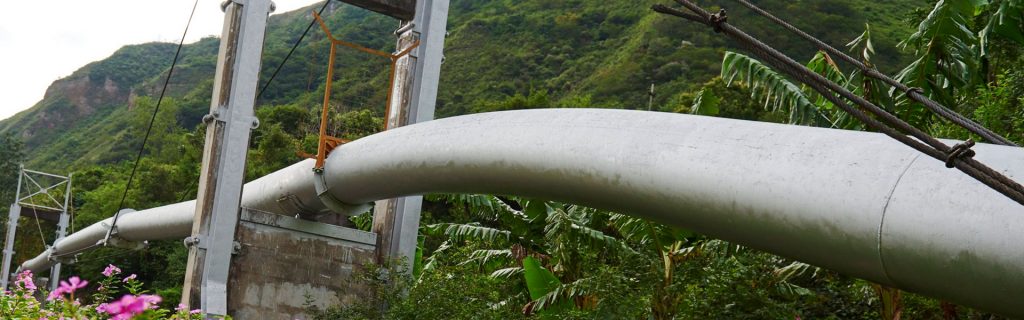
The North Peruvian Pipeline (NPP) is a critical component of Peru’s energy infrastructure, transporting crude oil from the northern Amazon region to the country’s Pacific coast. Given its strategic importance, it has been officially designated as a National Critical Infrastructure Asset.
The NPP is currently operational and available for hydrocarbon transportation. To maintain this status, a Master Comprehensive Maintenance Plan is implemented across its three segments — Segment I, Segment II, and the Northern Branch (NB) — carried out by technically qualified contractors in compliance with Supreme Decree No. 081-2007-EM (Regulations for Hydrocarbon Pipeline Transport).
Works include pipeline coating rehabilitation, remediation of metal loss anomalies, and full pipe segment replacement where technically required. All activities are overseen by Osinergmin (Peru’s national energy and mining regulatory authority), which has formally approved the works and confirmed full compliance with the established maintenance plans.
Prior to any maintenance work, an inline inspection (ILI) is conducted to identify segments requiring specialized intervention. The most recent ILI run used high-resolution magnetic flux leakage (MFL-HR) technology to assess wall thickness loss across the entire pipeline. Results are as follows:
These results confirm that the structural integrity of the pipeline is maintained. In addition to ILI, the NPP right-of-way (ROW) is continuously monitored through ground and aerial patrols — including drone surveillance — to detect potential hazards, hydrocarbon seepage indicators, and any unauthorized activities within the pipeline safety corridor. These activities are also subject to ongoing regulatory oversight by Osinergmin.
To protect the pipeline from erosion and river channel migration, riverbank protection structures have been constructed using riprap, rock embankments, and engineered fill.
In the Amazonas region, at Km 433.8 of Segment II, geotextile sandbag revetments were installed along the riverbank.
Similar protection works were carried out around the facilities of Pump Station 9, including access road rehabilitation, channel clearing, riprap placement, and reinforcement works along three active erosion fronts: the Huancabamba River, Tasajeras Creek, and Piquijaca Creek.
Channel realignment works have been executed at critical locations to mitigate the risk of watercourse migration undermining the pipeline, primarily between Km 341 and Km 399 of Segment II.
Slope stabilization works were carried out at Km 323+190, Km 398+200, Km 496.1, and Km 408 to prevent pipeline exposure due to mass movements.
At Km 484+170, where slope instability posed a risk to buried pipe, an aerial pipeline span supported by a suspension bridge structure was constructed to carry the line above ground and protect it from soil movement.
Vegetation clearing and maintenance is carried out along the full NPP right-of-way across all segments, keeping the corridor accessible for inspection, maintenance, and emergency response operations.
The NPP is equipped with an impressed current cathodic protection (ICCP) system to prevent external corrosion of the steel pipeline. Maintenance activities include inspection rounds, electrochemical potential measurements, and rectifier and anode bed repairs to ensure the system remains fully operational.
Maintenance activities at all NPP pump stations cover turbines, motor-generators, process instrumentation, storage tanks, and auxiliary systems.
Additionally, the secondary containment areas at Station 1 have undergone waterproofing rehabilitation. At Bayóvar Marine Terminal, the loading arms used for crude oil ship loading and unloading have been maintained and the sheet pile structure of the minor berth rehabilitated, improving dock operability.
A new twin-screw pump was installed and successfully commissioned for pumping operations through Segment I, with full SCADA integration allowing remote monitoring and control from both Station 1 and Bayóvar Terminal control rooms.
A specialized service is being executed for the inspection and quality control of composite sleeve reinforcements and failure analysis across the NPP and Northern Branch, using 3D scanning technology for high-precision defect characterization and fitness-for-service assessment.
The NPP corridor is monitored through a dedicated aerial surveillance service that uses machine learning algorithms to detect and classify hazards from drone imagery. The service also generates geospatial deliverables including orthomosaics, cross-sections, longitudinal profiles, contour maps, and digital terrain models (DTMs) for pipeline integrity and ROW management.
Real-time pipeline pressure monitoring is supported by 21 remotely operated automatic block valves distributed across the system: 5 on Segment I, 6 on Segment II, and 10 on the Northern Branch. These valves are capable of automatically isolating pipeline sections upon a pressure anomaly alert received at the Bayóvar Terminal control room, minimizing spill volume in the event of a leak.
Aboveground pipe sections supported on driven pile foundations were installed in priority areas near Station 1 to prevent differential settlement of main pipeline segments.
The subfluvial (river-bottom) crossing of the Northern Branch at the Pastaza River was rehabilitated with the installation of a new pipeline spool. Two emergency shutdown (ESD) valves were installed on each riverbank, each equipped with solar photovoltaic power systems and CCTV cameras, and integrated into the SCADA network for remote monitoring from the Bayóvar control room. Osinergmin issued a favorable technical opinion for the resumption of pumping operations through this segment following the rehabilitation.

